
Introduction: How Dental Implant Lead Generation Drives Predictable Growth
Dental implant lead generation is one of the most competitive and most profitable growth channels for modern dental clinics. A single accepted implant case can generate $3,000 to $6,000 or more, yet many practices struggle to create consistent monthly implant case flow.
The issue is not demand. Patients are actively searching for full mouth dental implants, All-on-4 treatments, and dental implants near me. The real problem is the lack of a structured dental implant marketing strategy.
Many clinics rely on generic dental advertising or broad “dentist near me” campaigns that focus on traffic instead of case value. Without high-intent keyword targeting, a conversion-optimized implant landing page, and proper tracking infrastructure, dental implant advertising becomes expensive and unpredictable.
A performance-driven system combines Google Ads for dental implants, local SEO, conversion architecture, and consultation optimization — turning search demand into measurable revenue.
This guide explains how to build a scalable dental implant lead generation system designed to generate predictable, high-value implant patients in 2026 and beyond.
What Is Dental Implant Lead Generation?
Dental implant lead generation is the structured process of attracting, qualifying, and converting high-intent patients actively searching for dental implant treatments including single tooth implants, full mouth dental implants, and All-on-4 procedures.
Unlike general dental marketing, which promotes cleanings, fillings, or broad “dentist near me” searches, dental implant marketing focuses on high-value procedures that require a different acquisition strategy. Implant patients conduct deeper research, compare providers, evaluate financing options, and seek proven expertise before booking a consultation.
A successful dental implant lead generation system includes:
- Strategic high-intent keyword targeting
- Performance-driven Google Ads for dental implants
- Consultation-focused landing page funnels
- Case acceptance and follow-up optimization
In simple terms, dental implant lead generation is not about increasing website traffic. It is about attracting the right patients/individuals actively researching implant solutions and financially prepared to move forward with treatment.
Implant Marketing vs. Generic Dental Marketing
Many clinics make a costly mistake: they promote dental implants using a general dentistry marketing strategy.
That approach fails because implant patients behave differently. They conduct deeper research, compare providers, evaluate financing options, and make higher-stakes decisions.
Below is the fundamental difference between generic dental marketing and structured dental implant lead generation:
| Generic Dental Marketing | Dental Implant Lead Generation |
| Focus on appointment volume | Focus on case value and revenue |
| Broad keywords (“dentist near me”) | High-intent implant keywords |
| Homepage traffic | Dedicated implant landing pages |
| Minimal financial positioning | Financing + trust emphasis |
| Low-ticket treatments | High-ticket cases ($3,000–$6,000+) |
Generic dental advertising aims to increase overall patient flow.
Dental implant marketing is revenue-driven. It prioritizes qualified consultations and accepted implant cases over raw lead volume.
If a hygiene appointment generates $150 and a single implant case generates $4,000 or more, your acquisition strategy, budget allocation, and tracking model must reflect that difference.
Implant marketing is not about more appointments it is about higher-value growth.
The Revenue Math Behind Dental Implant Growth
Dental implant lead generation becomes powerful when you look at the numbers.
Example (U.S. market):
- Average implant case value: $4,000
- Cost per implant lead: $120
- Case acceptance rate: 40%
If your campaign generates 25 implant leads:
- 25 leads
- 10 book consultations (40%)
- 4 accept treatment (40%)
That results in:
Revenue:
4 cases × $4,000 = $16,000
Ad Spend:
25 leads × $120 = $3,000
Return on Ad Spend (ROAS):
$16,000 ÷ $3,000 = 5.3x
In simple terms:
Invest $3,000 in dental implant advertising → generate $16,000 in implant revenue.
This is why dental implant marketing is one of the most scalable growth channels for modern practices. When your lead cost and case acceptance are controlled, revenue becomes predictable — not random.
Why Most Dental Implant Marketing Campaigns Fail
Despite the high revenue potential, many dental implant marketing campaigns underperform. Clinics experience inconsistent leads, low-quality inquiries, or rising cost per dental implant lead.
The problem is rarely demand. Patients search for dental implants every day.
The real issue is a broken marketing system.
Here are the five most common reasons dental implant lead generation fails:
1. No Structured Implant Funnel
Many clinics run Google Ads for dental implants and send traffic to their homepage.
A homepage is built for:
- General dentistry
- Multiple services
- All patient types
Implant patients need:
- Focused implant messaging
- Clear financing options
- Before-and-after proof
- Immediate consultation CTA
Without a dedicated implant landing page, conversion rates drop and lead costs rise. Implant marketing requires a consultation funnel — not a general website visit.
2. Targeting Broad Instead of High-Intent Keywords
Bidding on terms like:
- dentist near me
- cosmetic dentist
- tooth replacement
brings traffic — but not implant-ready patients.
High-intent keywords include:
- dental implants near me
- full mouth dental implants
- All-on-4 dental implants
- affordable dental implants [city]
Precision targeting improves case quality and reduces wasted ad spend.
3. No Tracking or Revenue Attribution
If you cannot measure cost per accepted implant case, you cannot optimize profitably.
Many clinics lack:
- Proper conversion tracking
- Call tracking
- CRM source attribution
Without data, agencies optimize clicks — not revenue. Implant marketing must be measured at the case level.
4. Weak Landing Pages
Common issues:
- No financing clarity
- No testimonials
- No doctor authority
- Poor mobile experience
Implant patients are making a high-ticket decision. Trust and clarity are critical.
An optimized implant landing page can convert at 8–18%. A weak page may sit below 3%. That difference alone can double lead volume without increasing budget.
5. Poor Follow-Up Systems
Dental implants require consultation and financial discussion.
If your team responds hours later, competitors win the case.
Speed-to-lead under 10 minutes significantly increases consultation bookings. Without structured follow-up, even strong dental implant advertising fails at the revenue stage.
Most implant campaign failures are not caused by competition or high CPCs.
They are caused by:
- Structural gaps
- Weak targeting
- Poor conversion systems
- Lack of revenue tracking
Before increasing your dental implant advertising budget, fix the system.
The 4-Part Dental Implant Lead Generation System
Successful dental implant lead generation is not about running ads. It is about building a structured acquisition system designed for high-value implant cases.
A predictable implant growth model includes four components:
- High-Intent Traffic Acquisition
- Conversion-Optimized Implant Landing Page
- Tracking & Attribution Infrastructure
- Case Acceptance & Follow-Up Optimization
When these work together, implant marketing becomes predictable — not inconsistent.
1. High-Intent Traffic Acquisition
The foundation of dental implant marketing is capturing patients at the moment they search:
- dental implants near me
- full mouth dental implants
- All-on-4 dental implants
- affordable dental implants [city]
Google Ads for dental implants is the primary revenue driver because it captures active demand.
A strong campaign structure includes:
- Exact and phrase match implant keywords
- Negative keyword filtering
- Geo-targeted bidding
- Conversion-focused bidding strategy
The goal is not cheap clicks. The goal is cost per accepted implant case.
Meta ads (Facebook and Instagram) support search by promoting financing, before-and-after results, and local authority — but high-intent search remains the core driver.
2. Conversion-Optimized Implant Landing Page
Traffic without conversion structure wastes budget.
Implant patients need:
- Clear implant-focused messaging
- Early financing clarity
- Before-and-after proof
- Doctor credibility
- Strong consultation CTA
- Mobile-first design
An optimized implant landing page can convert at 8–18%. A weak page often stays below 3%, doubling your cost per dental implant lead.
3. Tracking & Attribution Infrastructure
Without tracking, implant marketing becomes guesswork.
A performance-driven system requires:
- Conversion tracking
- Call tracking
- CRM integration
- Lead source attribution
This allows you to measure:
- Cost per implant lead
- Consultation rate
- Case acceptance rate
- Cost per accepted implant case
- True ROAS
Revenue-level data identifies exactly where the funnel breaks.
4. Case Acceptance & Follow-Up Optimization
Dental implant lead generation does not end at form submission.
Implant patients require:
- Response within 10 minute
- Structured consultation scheduling
- Clear financial discussion
- Trust-building communication
Improving case acceptance from 30% to 45% can increase revenue significantly — without increasing ad spend.
When these four layers operate together:
Traffic → Landing Page → Tracking → Consultation → Case Acceptance
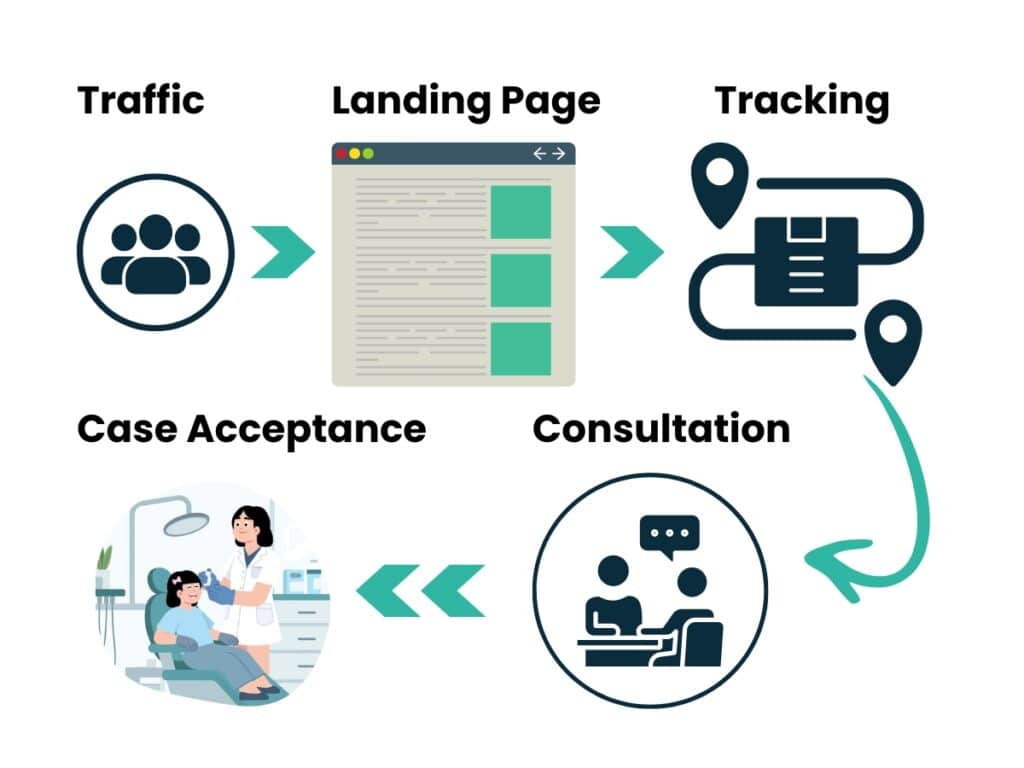
You create a scalable dental implant growth engine.
Remove one layer, and performance declines.
This is how structured dental implant marketing turns ad spend into predictable monthly case flow.
Cost Per Dental Implant Lead in 2026 (By Country)
One of the most common questions clinic owners ask is:
“What is a good cost per dental implant lead?”
The answer depends on competition, location, landing page quality, and case value. However, benchmark ranges provide useful guidance.
Dental Implant Lead Cost Benchmarks (2026)
| Country | Average Cost Per Implant Lead |
| USA | $60 – $180 |
| Canada | $50 – $140 |
| Australia | $60 – $160 |
| Dubai (UAE) | $40 – $120 |
| India | ₹300 – ₹1,500 |
These are performance-based averages from competitive markets.
What Influences Cost Per Dental Implant Lead?
1. Market Competition
Highly competitive urban areas (e.g., major cities) typically have higher cost per click due to advertiser density, which increases cost per implant lead.
2. Keyword Intent
High-intent keywords such as:
- dental implants near me
- full mouth dental implants
- All-on-4 dental implants
cost more — but convert better.
Broad keywords like:
- dentist
- cosmetic dentistry
- tooth pain
generate cheaper traffic but lower implant conversion rates.
Higher intent usually means higher profitability.
3. Landing Page Conversion Rate
Your implant landing page directly impacts cost per lead.
Example:
If CPC = $12
- 10% conversion rate → $120 per lead
- 4% conversion rate → $300 per lead
Small conversion improvements dramatically reduce lead cost.
4. Budget & Impression Share
Low budgets often result in:
- Limited visibility
- Inconsistent data
- Poor algorithm optimization
Stable dental implant advertising requires sufficient budget to maintain impression share.
Is a $150 Implant Lead Expensive?
Not necessarily.
Example:
- $150 per lead
- 20 leads
- 8 consultations
- 3 accepted cases
- $4,000 average case value
Revenue = $12,000
Ad Spend = $3,000
ROAS = 4x
The real KPI is cost per accepted implant case, not cost per lead.
Ideal Performance Benchmarks
For a healthy dental implant lead generation system:
- Landing page conversion rate: 8–18%
- Consultation booking rate: 40–60%
- Case acceptance rate: 30–50%
- Cost per accepted case: Under 25–35% of treatment value
Dental implant marketing should be evaluated on revenue performance — not vanity metrics.
Budget Planning for Dental Implant Advertising
A predictable dental implant lead generation system requires structured investment. Underfunded campaigns almost always produce inconsistent results — not because the strategy is wrong, but because the data volume is too low to optimize properly.
Dental implant advertising operates in a competitive search auction. Your budget directly impacts:
- Impression share
- Visibility on high-intent keywords
- Data volume for optimization
- Stability of lead flow
When budgets are too small, ads appear inconsistently, performance fluctuates, and cost per implant lead becomes unstable.
The real question is not:
“How little can we spend?”
The better question is:
“What level of investment produces stable, profitable implant case flow?”
Implant marketing should be treated as a revenue engine — not a test campaign. When budget aligns with case value and market competition, dental implant lead generation becomes predictable and scalable.
Minimum Viable Dental Implant Advertising Budget
To generate consistent results from Google Ads for dental implants, your campaign must have enough budget to capture meaningful search volume and allow algorithm optimization.
Below are practical starting benchmarks for competitive markets:
| Market | Recommended Monthly Budget |
| USA | $2,000 – $8,000 |
| Canada | $1,500 – $6,000 |
| Australia | $1,500 – $6,000 |
| Dubai | $1,500 – $5,000 |
| India | ₹40,000 – ₹2,00,000 |
These ranges support stable dental implant lead generation in medium-to-competitive areas.
Budgets below these levels often lead to:
- Low impression share on high-intent implant keywords
- Insufficient data for smart bidding optimization
- Inconsistent lead volume
- Higher cost per dental implant lead
- Difficulty measuring true cost per accepted case
Dental implant advertising relies on data volume. Without enough traffic and conversions, machine learning cannot optimize effectively.
A minimum viable budget is not about overspending — it is about generating enough qualified implant leads to create predictable case flow.
Impression Share Strategy for Dental Implant Advertising
In dental implant advertising, consistency matters more than short bursts of visibility.
If your ads appear:
- Only 30% of the time
- During limited hours
- In restricted geographic areas
You will miss high-intent searches from patients actively looking for dental implants.
Implant patients do not wait. If your ad is not visible, they click a competitor.
For stable dental implant lead generation, aim for:
- 60–80% impression share on core implant keywords
- Geo-focused targeting within a profitable service radius
- Dayparting based on real conversion data
- Strong presence on high-intent search terms
High impression share increases:
- Qualified consultation volume
- Brand authority
- Case consistency
Budget controls visibility.
Visibility controls lead stability.
Lead stability drives predictable implant revenue.
If your goal is consistent case flow, impression share must be treated as a strategic KPI — not an afterthought.
Scaling Framework for Dental Implant Campaigns
Once your dental implant lead generation system achieves a profitable cost per accepted implant case, scaling should be controlled and data-driven — not aggressive.
Sudden budget increases often disrupt algorithm stability and raise cost per implant lead.
A structured scaling strategy includes:
- Increase budget by 15–25% at a time
- Monitor cost per dental implant lead and cost per accepted case
- Expand high-performing implant keyword groups
- Gradually widen geographic targeting
- Test new implant-focused ad variations and messaging
The goal of scaling is not more leads.
The goal is more profitable implant cases.
When scaling is controlled, performance remains stable and return on ad spend (ROAS) stays predictable.
Aggressive budget doubling can spike costs and reduce efficiency.
Incremental scaling preserves algorithm learning and protects profitability.
Dental implant advertising should scale like a revenue engine — measured, optimized, and aligned with case capacity.
ROAS Modeling for Dental Implant Campaigns
Before launching any dental implant advertising campaign, you should model your expected return on ad spend (ROAS).
Implant marketing should be forecasted — not guessed.
Example Revenue Model
- Monthly ad budget: $4,000
- Target cost per dental implant lead: $120
- Estimated leads: 33 leads
From those 33 leads:
- 50% book consultations → 16 consultations
- 40% accept treatment → 6 accepted implant cases
If your average implant case value is $4,000:
Projected Revenue:
6 cases × $4,000 = $24,000
Ad Spend:
$4,000
Projected ROAS:
$24,000 ÷ $4,000 = 6x
This type of forward modeling clarifies expectations, aligns marketing with production goals, and sets measurable targets for your dental implant lead generation system.
When ROAS is modeled in advance, decisions become strategic — not emotional.
Why Low Budgets Limit Dental Implant Growth
When clinics allocate minimal budgets to dental implant advertising, growth becomes unstable.
Low investment often leads to:
- Data starvation
- Overreliance on automated bidding without sufficient conversion volume
- Weak optimization feedback loops
- Inability to compete for high-intent implant keywords
- Inconsistent dental implant lead flow
Google Ads for dental implants relies on data. Without enough clicks and conversions, the algorithm cannot optimize cost per dental implant lead effectively.
Implant marketing is not a short-term test. It is a revenue engine.
Clinics serious about scaling high-value treatments allocate budget proportionate to potential case value. If an accepted implant case generates $4,000 or more, the advertising strategy must reflect that economic reality.
The objective is not aggressive spending. It is structured profitability.
When your cost per accepted implant case stays well below treatment value, scaling becomes a calculated business decision — not a financial risk.
Local SEO for Dental Implants
While paid advertising generates immediate implant leads, local SEO builds long-term visibility and authority.
Most high-intent implant searches include local modifiers such as:
- dental implants near me
- full mouth dental implants [city]
- implant dentist in [location]
- All-on-4 dental implants near me
Ranking for these searches — especially in the Google Map Pack — can generate consistent implant consultations without increasing your dental implant advertising budget.
Local SEO strengthens your dental implant lead generation system by:
- Increasing organic visibility
- Reducing long-term cost per implant lead
- Building local trust and authority
- Supporting paid campaign performance
When your clinic appears in paid ads, organic results, and the Map Pack simultaneously, you dominate search real estate and improve consultation conversion rates.
A structured local SEO strategy ensures your practice remains visible to high-intent implant patients — even when ad spend fluctuates.
Google Business Profile Optimization for Implant Rankings
Your Google Business Profile (GBP) is one of the most powerful assets for local dental implant SEO. In competitive markets, proper GBP optimization can significantly improve visibility in the Google Map Pack.
To rank higher for dental implant searches:
- Select the correct primary category (Dentist or Cosmetic Dentist, based on positioning)
- Add implant-related services in the Services section (e.g., dental implants, full mouth dental implants, All-on-4)
- Use implant keywords naturally in your business description
- Upload high-quality before-and-after images (where compliant)
- Publish weekly implant-focused posts
- Maintain consistent NAP (Name, Address, Phone) across all listings
Consistency, activity, and relevance are key ranking signals.
Google prioritizes complete and actively managed profiles — especially for high-value searches like dental implants near me.
A fully optimized Google Business Profile strengthens your local SEO strategy and supports long-term dental implant lead generation without increasing ad spend.
Review Strategy Targeting Implant Keywords
Patient reviews are not only trust signals — they are powerful local SEO ranking signals.
For dental implant lead generation, reviews should reinforce implant-related relevance in the Google Map Pack.
Encourage implant patients to naturally mention:
- dental implants
- full mouth dental implants
- All-on-4 treatment
- implant procedure experience
- implant consultation
For example:
Instead of a generic review like:
“Great dentist.”
A stronger, implant-focused review would be:
“I had full mouth dental implants done here and the entire experience — from consultation to surgery — was professional and reassuring.”
These natural keyword mentions improve your profile’s topical relevance for high-intent searches like dental implants near me.
The key is authenticity. Never script or force reviews — simply guide satisfied implant patients to describe their treatment experience clearly.
Keyword-rich, experience-based reviews strengthen both conversion trust and local search visibility.
Location-Specific Implant Pages
If your clinic serves multiple cities or neighborhoods, dedicated location pages are essential for ranking in local dental implant searches.
Instead of one generic implant page, create pages such as:
- Dental Implants in [City Name]
- Full Mouth Dental Implants in [Area Name]
- All-on-4 Dental Implants in [Location]
These pages improve visibility for geo-modified searches like dental implants near me and implant dentist in [city].
Each location page should include:
- Unique, localized content (not copied from other pages)
- References to the specific city or neighborhood
- Testimonials from patients in that area
- An embedded Google Map
- Location-specific FAQs
- Clear consultation call-to-action
Avoid duplicate content at all costs. Simply changing the city name is not enough. Google prioritizes genuinely localized pages with real relevance.
Properly structured location-specific implant pages strengthen local SEO authority and support consistent dental implant lead generation across multiple service areas.
NAP Consistency & Local Citations
Inconsistent Name, Address, and Phone number (NAP) information weakens local SEO performance and reduces visibility in the Google Map Pack.
For dental implant marketing, accuracy across all listings is essential.
Ensure:
- Your website footer matches your Google Business Profile exactly
- All directory listings display the same NAP details
- No outdated phone numbers or addresses exist online
- Major local citations are complete and consistent
Even small variations (abbreviations, suite numbers, formatting differences) can dilute trust signals.
Citation consistency strengthens local authority and improves rankings for high-intent searches such as dental implants near me.
Combining Paid Ads + Local SEO
The most effective dental implant lead generation strategy integrates paid advertising with local SEO.
- Google Ads for dental implants provides immediate visibility and captures active demand.
- Local SEO optimization builds long-term authority and organic consultation flow.
When your clinic appears:
- At the top of paid search results
- Inside the Google Map Pack
- In organic rankings
You dominate search real estate and increase patient trust.
This integrated approach reduces long-term cost per implant lead while strengthening brand authority.
In competitive markets, local SEO for dental implants is not optional — it is a compounding asset. Over time, it reduces dependency on paid advertising while supporting a scalable implant marketing strategy.
How to Measure ROI from Dental Implant Marketing
Running ads is not a success.
Generating profitable implant cases is.
To evaluate your dental implant lead generation system, you must track revenue-based metrics — not just clicks or impressions.
Here are the five core KPIs that determine profitability:
1. Cost Per Dental Implant Lead (CPL)
Formula:
Ad Spend ÷ Number of Implant Leads = Cost Per Lead
Example:
$3,000 ÷ 25 leads = $120 CPL
CPL is your entry metric — but it does not determine profitability on its own.
2. Cost Per Consultation
Not every implant leads to book appointments.
If:
25 leads → 12 consultations
Booking rate = 48%
Formula:
Ad Spend ÷ Booked Consultations
This metric reveals front-desk performance and speed-to-lead efficiency.
3. Case Acceptance Rate
Formula:
Accepted Cases ÷ Consultations
Example:
12 consultations → 5 cases
Acceptance rate = 41%
Improving acceptance from 30% to 45% can significantly increase revenue without increasing ad spend.
4. Cost Per Accepted Implant Case (Most Important KPI)
Formula:
Total Ad Spend ÷ Accepted Cases
Example:
$3,000 ÷ 5 cases = $600 per accepted case
If your average implant case value is $4,000, your acquisition cost is 15% of treatment value — a strong margin.
5. Return on Ad Spend (ROAS)
Formula:
Total Implant Revenue ÷ Ad Spend
Example:
$20,000 ÷ $3,000 = 6.6x ROAS
This reflects full-funnel performance — from lead to revenue.
Dental implant marketing should always be evaluated at the case and revenue level.
Clicks do not grow practices.
Accepted implant cases do.
Why Most Clinics Miscalculate ROI
Many clinics believe their dental implant marketing is underperforming — when in reality, they are measuring the wrong metrics.
Common mistakes include:
- Tracking only form submissions
- Ignoring phone call attribution
- Failing to integrate CRM data
- Not tracking accepted implant case value
- Measuring total monthly revenue without lead source tagging
If you cannot trace a dental implant lead from click → consultation → accepted case → revenue, your ROI calculation is incomplete.
Without full-funnel tracking, dental implant lead generation becomes guesswork. Decisions are made on partial data instead of profitability.
Implant marketing must be measured at the case and revenue level — not at the lead level.
Ideal Performance Benchmarks
A healthy dental implant lead generation system typically shows:
- Cost per dental implant lead (CPL): Within market benchmark range
- Consultation booking rate: 40–60%
- Case acceptance rate: 30–50%
- Cost per accepted implant case: Under 25–35% of treatment value
- Return on ad spend (ROAS): 4x–8x, depending on competition
When these metrics align, implant marketing becomes structured and scalable — not dependent on short-term advertising spikes.
Strong ROI is not about generating more leads.
It is about building a measurable system that converts demand into profitable implant cases.
Revenue Engineering vs. Traffic Marketing
Many generic agencies optimize surface-level metrics:
- Click-through rate (CTR)
- Cost per click (CPC)
- Impressions
These numbers may look good on reports — but they do not guarantee profitable implant cases.
Performance-driven dental implant marketing focuses on what actually grows a practice:
- Cost per accepted implant case
- Average case value
- Return on ad spend (ROAS)
- Revenue scalability
That difference defines sustainable growth.
Dental implant lead generation is not about “getting more leads.”
It is about engineering a predictable revenue system:
Lead → Consultation → Case Acceptance → Revenue
Each stage must be measurable, optimized, and aligned with profitability.
Without full-funnel revenue tracking, marketing cannot be improved intelligently.
You can optimize traffic endlessly — but only revenue engineering builds a scalable implant growth engine.
Who This Dental Implant Marketing System Is For
Not every clinic needs a structured dental implant lead generation system.
This model is designed for practices that treat dental implants as a core revenue driver — not an occasional add-on service.
Implant-Focused Practices
This system is ideal for clinics that:
- Offer single implants and full mouth dental implants
- Provide All-on-4 or full-arch solutions
- Have surgical capability in-house
- Position implants as a premium treatment
If implants represent a significant revenue opportunity in your practice, structured lead generation becomes essential.
Multi-Location Dental Clinics
Multi-location practices often face:
- Inconsistent implant lead flow across branches
- Uneven performance by city
- Difficulty tracking cost per accepted implant case by location
A centralized dental implant advertising system enables:
- Geographic budget allocation
- Performance comparison by clinic
- Standardized consultation processes
- Scalable growth across locations
Clinics Willing to Invest in Structured Growth
Dental implant marketing requires strategic investment.
This system is best suited for clinics prepared to:
- Invest in Google Ads for dental implants
- Build conversion-optimized implant landing pages
- Implement full tracking and attribution
- Improve consultation and follow-up processes
Clinics expecting strong ROI from minimal budgets or without operational readiness will struggle to achieve predictable results.
Revenue-Focused Practices
If your main KPI is “number of leads,” you may generate volume — but not profitability.
This system is built for clinics that prioritize:
- Cost per accepted implant case
- Revenue per treatment
- Long-term scalability
- Performance accountability
Implant marketing must be measured at the revenue level.
Who This System Is Not For
This approach is not ideal for:
- Clinics offering implants occasionally
- Practices unwilling to implement tracking
- Teams without consultation capacity
- Clinics expecting instant results without optimization
Predictable dental implant lead generation requires structure, data, and operational discipline.
A true dental implant marketing system does not sell traffic.
It builds revenue architecture.
If your clinic views implants as a strategic growth lever, implementing a structured acquisition system becomes a competitive advantage — especially in saturated markets.
Conclusion: Build a Predictable Dental Implant Lead Generation System
Dental implant lead generation is not about running ads.
It is about engineering a measurable, scalable growth system.
When high-intent traffic acquisition, conversion-optimized implant landing pages, tracking infrastructure, and case acceptance processes operate together, dental implant marketing becomes predictable — not inconsistent.
Most clinics do not struggle because of competition.
They struggle because their marketing system lacks structure.
If your practice wants:
- Consistent implant consultations
- Lower cost per accepted implant case
- Clear ROI tracking and revenue visibility
- Scalable dental implant advertising
- Integrated local SEO and paid search dominance
Then your strategy must move beyond generic dental marketing.
Predictable implant growth requires revenue engineering — not traffic generation.
Digital Pixelance builds structured dental implant lead generation systems focused on measurable case acquisition, profitability, and long-term scalability.
Because sustainable implant growth is built on performance — not vanity metrics.
FAQs About the Dental Implant Lead Generation System
What is a dental implant lead generation system?
A dental implant lead generation system is a structured marketing framework designed to attract high-intent implant patients, convert them into consultations, and track accepted cases. It combines Google Ads, conversion-focused landing pages, local SEO, and revenue tracking to produce predictable implant case flow.
How much does a dental implant lead generation system cost?
In competitive markets, clinics typically invest between $2,000 and $8,000 per month in dental implant advertising. The key metric is not total spend, but cost per accepted implant case compared to treatment value.
What is a good cost per dental implant lead?
In the U.S., cost per dental implant lead typically ranges from $60 to $180. However, profitability should be measured by cost per accepted implant case, not cost per lead alone.
Are Google Ads necessary for implant lead generation?
Yes. Google Ads captures high-intent searches like “dental implants near me” and is usually the primary revenue driver. Local SEO supports long-term visibility but takes time to build.
How long does it take to see results?
Clinics can begin generating implant leads within 1–2 weeks of launching Google Ads. Optimization of cost per lead and case acceptance typically requires 30–90 days of structured testing.
What is the biggest mistake in implant marketing?
The most common mistake is sending paid traffic to a generic homepage without proper tracking or follow-up. Implant campaigns require dedicated landing pages, high-intent keyword targeting, and revenue-level measurement.
How many implant leads do I need per month?
The required volume depends on booking and case acceptance rates. For many clinics, 25–40 qualified implant leads per month can produce consistent case flow when properly converted.